Health and Safety Policy for Landscaping Brompton
 This health and safety policy sets out the standards and responsibilities expected across all landscaping Brompton activities. It is designed to protect employees, contractors, clients, visitors, and members of the public from avoidable harm while ensuring that outdoor work is carried out efficiently and responsibly. Our approach is based on prevention, awareness, and continuous improvement, with every task assessed for risk before work begins.
The nature of landscaping services can involve manual handling, machinery, sharp tools, powered equipment, vehicle movements, uneven ground, and exposure to changing weather conditions. Because of this, safety must be considered at every stage of a project. We expect all personnel involved in garden maintenance, site preparation, planting, turfing, pruning, and hard landscaping to follow safe systems of work and report concerns immediately.
 This policy applies to all work carried out under our control, whether on private gardens, commercial premises, or communal outdoor spaces. It also applies to subcontractors and temporary staff who are expected to meet the same standards as permanent team members. Landscaping Brompton safety is not treated as a separate task; it is part of the way work is planned, delivered, and reviewed every day.
We are committed to identifying hazards early and reducing risk through careful planning, suitable equipment, and clear communication. Before any job starts, the work area should be checked for obstacles, underground services where relevant, unstable surfaces, access restrictions, and potential hazards caused by weather or nearby activity. If conditions change during the day, the task must be paused and reassessed.
Risk assessments and method statements should be proportionate to the task, taking into account the size of the site, the tools being used, and the experience of the team. Where necessary, control measures may include exclusion zones, traffic management, protective barriers, warning signs, and supervised access. Landscape health and safety relies on planning that is practical, visible, and understood by everyone on site.
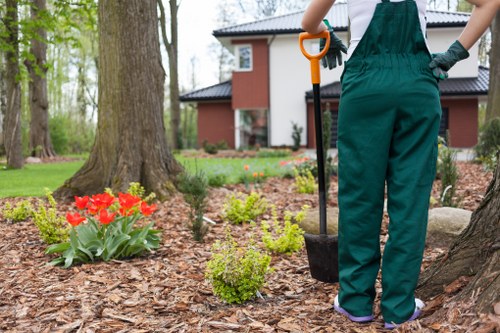 All workers must be provided with appropriate personal protective equipment and must use it correctly. This may include gloves, safety boots, eye protection, hearing protection, high-visibility clothing, and weather-appropriate clothing. PPE is not a replacement for safe working methods, but it remains an essential layer of protection when carrying out gardening and landscaping operations.
Tools and machinery must be maintained in safe working order, inspected regularly, and used only by trained or competent individuals. Damaged equipment must be removed from service immediately. Fuel, batteries, electrical tools, and cutting equipment should be stored and handled in accordance with manufacturer instructions and site controls. Where machinery is in use, others must keep a safe distance and remain alert to moving parts, flying debris, and noise.
Manual handling is a significant concern in outdoor landscaping work. Loads should be assessed before lifting, and assistance or mechanical aids should be used where necessary. Workers should avoid twisting, overreaching, and repetitive strain by planning the task properly and using correct posture. Team members are encouraged to speak up if a load is too heavy, awkward, or unsafe to move alone.
At the midpoint of every project, supervisors should review progress, reassess risks, and confirm that site controls remain effective. 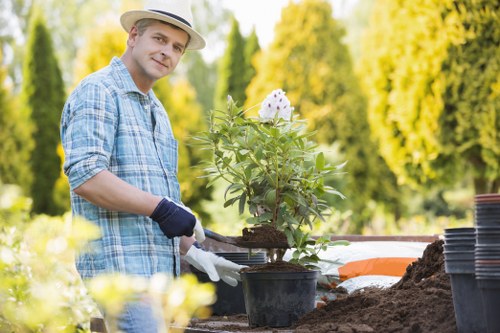 This is particularly important when tasks involve changing ground conditions, repeated deliveries, or multiple trades operating in the same area. A strong landscaping Brompton health and safety policy depends on consistent checks, not assumptions.
Weather can create additional hazards in landscaping. High winds, heavy rain, freezing temperatures, heat, and poor visibility may all affect safe working. Tasks should be modified, delayed, or stopped when conditions make work unsafe. Adequate hydration, rest breaks, and suitable clothing should be provided during hot or cold weather, and surfaces should be monitored for slips, trips, and falls.
Environmental responsibility is also part of safe working practice. Waste should be separated where possible, stored securely, and removed in a way that avoids contamination, obstruction, or fire risk. Fuels, oils, and chemicals must be handled carefully to prevent spills and exposure. When working near plants, wildlife, or water features, additional controls may be required to protect both people and the surrounding environment.
In the event of an accident, near miss, injury, or dangerous occurrence, the situation must be reported promptly and acted upon without delay. First aid provisions should be available, and emergency arrangements must be understood by everyone involved.  All incidents should be reviewed so that lessons can be learned and improvements made to future landscaping services.
We expect all team members to take personal responsibility for safety by following instructions, using equipment properly, wearing required PPE, and raising concerns early. Managers and supervisors are responsible for setting clear expectations, providing training, monitoring compliance, and stopping unsafe work where needed. Safety performance should be discussed regularly so that good practice becomes routine rather than exceptional.
This policy is reviewed periodically to ensure it remains suitable, effective, and aligned with the nature of our work. Where changes in equipment, staffing, working methods, or project scope introduce new risks, the policy and supporting procedures will be updated accordingly. Through careful management and shared responsibility, landscaping Brompton projects can be delivered safely, professionally, and with respect for everyone involved.